Furiosa: A Mad Max Saga
I let out the biggest FUCK YES when I found out the first trailer for Furiosa just dropped. And immediately out came all the haters to say “it looks too CGI – I loved the practical effects of Fury Road”.
Ah yes, Fury Road, the film that didn’t have any CGI at all.
One thing I noticed while looking over the old trailers for FR was this shot from the Comic-Con trailer (released July 2014)
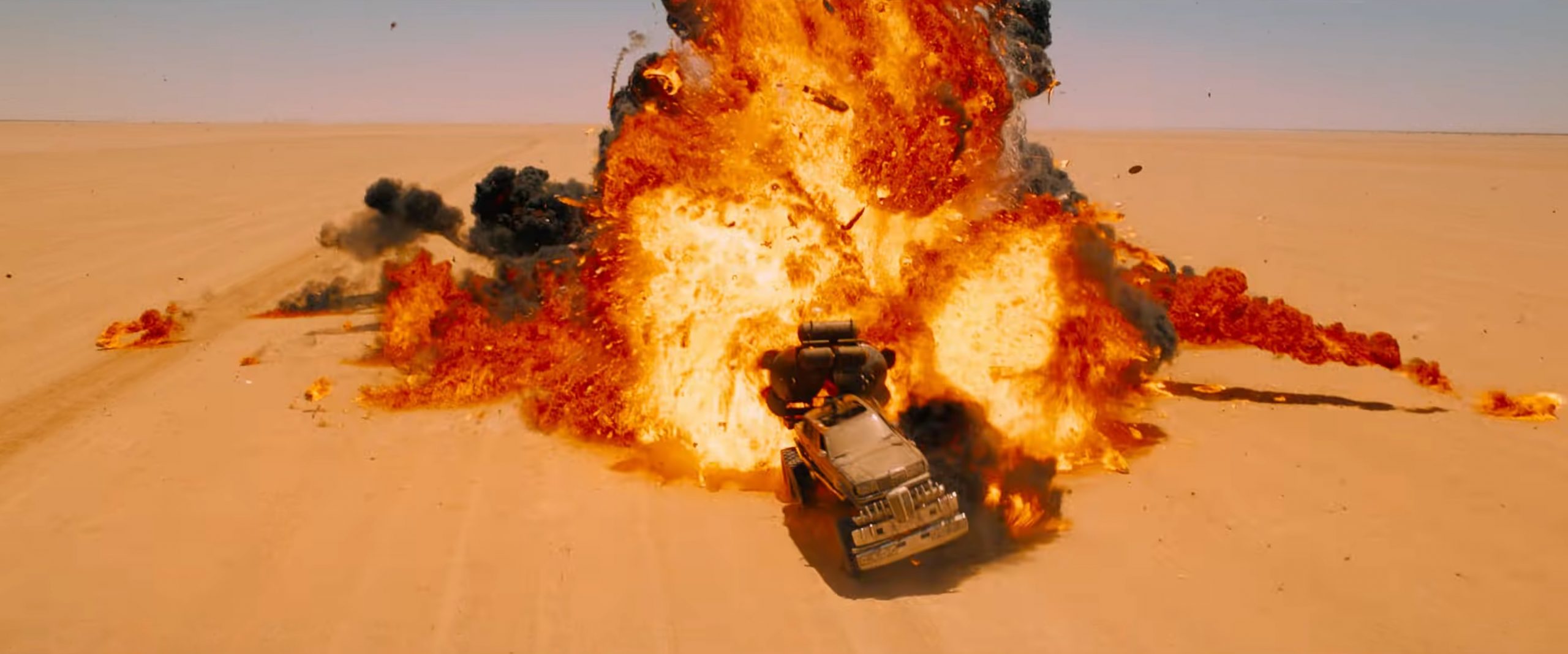
Compare this with the same shot from the final trailer (released December 2014)

Yep, no CGI at all.
The 100 Best Movies of the 1970s – Far Out »
What a list! The Godfather isn’t even in the top 10 and everything above it is a banger.
# Nov 21, 2023These 38 Reading Rules Changed My Life – Ryanholiday.net »
The rule I like is ‘one hundred pages minus your age.’ Say you’re 30 years old—if a book hasn’t captivated you by page 70, stop reading it. So as you age, you have less time to endure crap.
This post comes perilously close to one of those insufferable LinkedIn “if you’re not reading Marcus Aurelius from a beat-up paperback, are you really reading?” humblebrags, but I liked this rule in particular. The older I get, the more likely I am to DNF if a book isn’t holding me.
# Sep 25, 2023The Gist: Capital Crimes »
Government ministers had theatrical fits of the vapours at a piece of art depicting the police attending an historical eviction. They needn’t have worried. The image was clearly too subtle.
No artist would be so crude as to simply show the police force of the state standing guard at Bank Machines, protecting money against the people who own it.
And now, no one needs to.
I usually try to avoid anything too political over here, but this whole situation is just too bonkers to ignore, and Simon McGarr’s take is spot on.
# Aug 16, 2023Double Fine PsychOdyssey
Wait, shit, speaking about Tim Schafer, I should also throw some love at Double Fine’s PsychOdyssey which was released earlier this year! It’s an epic warts-and-all, 6 year long behind-the-scenes documentary about the making of Psychonauts 2. The BTS stuff we usually get for most games is part of the promotion of the game, and the PR people would never allow anything bad to be shown. PsychOdyssey, on the other hand, shows a company at its best and at its worst and it’s absolutely insane to me that a company would allow itself to be so candid. By the end, I was sobbing. Sobbing.
Honestly, even if you’re not into gamedev, this is worth your time, just because I don’t think we’ll ever see anything like it again.
Monkey Island 2 Lechucks Revengethe Commentary Tracks »
Ron Gilbert, Dave Grossman and Tim Schafer recorded a commentary for the special edition of Monkey Island 2 and now you can listen without having to play through the game. A great rambling conversation with three old friends about the process of making a classic game.
# Aug 5, 2023Everyone Is Beautiful and No One Is Horny Blood Knife »
When revisiting a beloved Eighties or Nineties film, Millennial and Gen X viewers are often startled to encounter long-forgotten sexual content content: John Connor’s conception in Terminator, Jamie Lee Curtis’s toplessness in Trading Places, the spectral blowjob in Ghostbusters. These scenes didn’t shock us when we first saw them. Of course there’s sex in a movie. Isn’t there always?
The answer, of course, is not anymore—at least not when it comes to modern blockbusters
Pretty insane that Oppenheimer, of all films, would be the exception that proves the rule.
# Aug 4, 2023Life Before Cellphones the Barely Believable After Work Activities of Young People in 2002 »
It’s incredible how things have changed in the last twenty years.
# Jun 23, 2023Sally: You had to plan more ahead and hope it worked out. People didn’t flake as much. There’s no option to text someone 10 minutes before, because you knew they were waiting for you.
Dan: Even if you didn’t feel like it, you just showed up. If you didn’t show up, people would stop inviting you out. And then you would have fun! Or maybe it would suck, but next time would be fun.
Matt: You’d be late or they’d be late and you’d just talk to whoever was there. It was a whole skill, taking to a person you don’t know.
Searching for a Search Engine »
DuckDuckGo was encouraging for focusing on privacy, but the quality of results has been underwhelming. Google has seemingly devolved from a genuine search engine to some sort of recommendation engine with low-quality generic “answers” surfaced by scraping content from sites.
Everything has just felt either sleazy, low-quality, or both.
If you’re anything like me and have been feeling pretty bummed out at the state of search on the modern web, you should read this. I hadn’t heard of Kagi before but I’ve been getting some good results from it so far.
# Jun 18, 2023Robin Sloan on the 'This Is How You Win the Time War'/Bigolas Dickolas Phenomenon »
# Jun 6, 2023This is a good thing happening to a great book and better people — but/and, there’s something unsettling about these algorithmic lightning bolts. From afar, watching the flash, it feels like the activity of a classical god. The algorithm’s choices are exactly that consequential; exactly that capricious.